
Ridderhof Martin Gallery
Sunday, November 2, 2pm
Presentations by:
Mason Moorman (“Street Art: Politics and Profit”)
Isabel Smith (“The Ballet Dancers of Edgar Degas: A Feminist Theoretical Perspective”)

Presentations by:
Mason Moorman (“Street Art: Politics and Profit”)
Isabel Smith (“The Ballet Dancers of Edgar Degas: A Feminist Theoretical Perspective”)
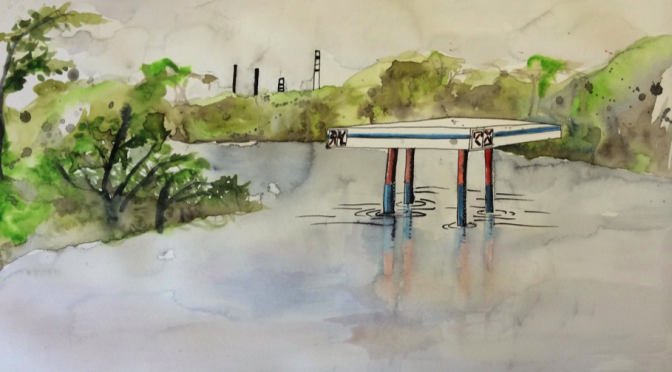
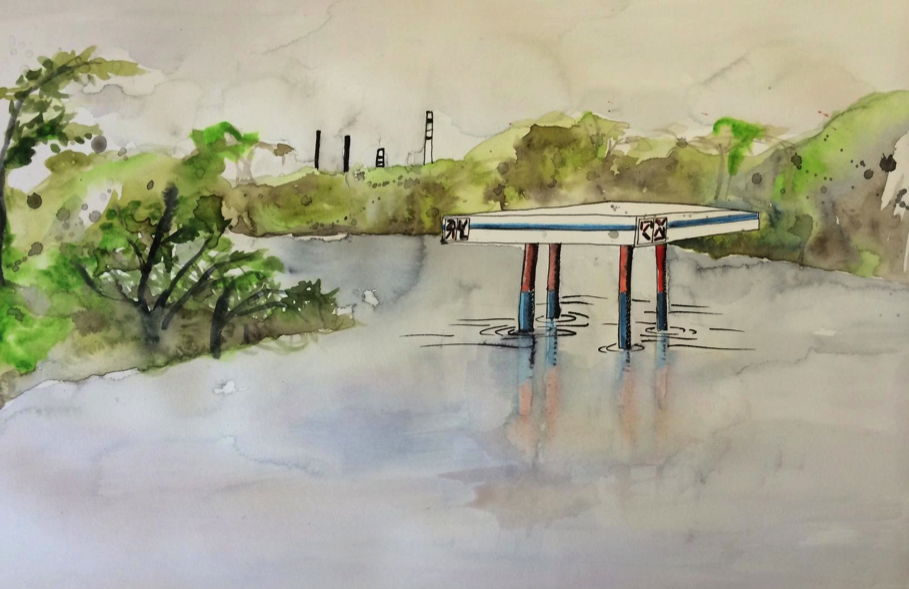

duPont Gallery will exhibit Antediluvian, an installation by Canadian artist, Mia Feuer (b. 1981). Feuer’s latest project was to be a temporary public sculpture located near Heritage Island in Washington, D.C. created as part of the 5×5 Public Art Festival, a large temporary public arts. Feuer’s envisioned project was a solar powered gas station that would have floated in the surrounding Anacostia River. However, the proposal was abruptly cancelled by community protestors due to environmental concerns.
The duPont Gallery will display the preliminary materials that went into this major project- drawings, maquettes, projections and recorded lectures on environmental issues held at the location of the original project in order to initiate a dialog about public art, questioning what an artwork’s commitment is to the public, the site, and to the artist.


The Ridderhof Martin Gallery will exhibit American Abstract Artists: 75th Anniversary Print Portfolio, an exhibition of 48 archival digital prints. Founded in 1936, the American Abstract Artists held its first exhibition the next year at the Squibb Gallery in New York City. The organization fosters the understanding of abstract and non-objective art by organizing exhibitions, producing print portfolios and catalogs as well as providing a forum for discussion through symposia, panels, and the American Abstract Artists Journal.
For the first time in its long history the AAA portfolio was printed digitally rather than using traditional forms of lithography or transferring image to plate, thereby engaging the rapidly changing technological field of the twenty-first century.


How do artists push beyond what they already know and readily see? Can acts of engagement and exploration be works of art in themselves? In this episode, artists use their practices as tools for personal and intellectual discovery, simultaneously documenting and producing new realities in the process.
While enlisting the participation of the residents of a Bronx public housing development to develop a sprawling installation out of everyday materials, Thomas Hirschhorn poses political and philosophical questions, and searches for alternative models of thinking and being. The process leads to the creation of a new kind of monument that, while physically ephemeral, lives on in collective memory. For Graciela Iturbide, the camera is a pretext for understanding the world. Her principal concern has been the photographic investigation of Mexico—her own cultural environment—through black-and-white images of landscapes and their inhabitants, abstract compositions, and self-portraits. Whether photographing indigenous communities in her native country, cholos in Los Angeles, Frida Kahlo’s house, or the landscape of the American South, her interest, she says, lies in what her heart feels and what her eyes see. Leonardo Drew, whose art career began as a child in inner city Bridgeport, Connecticut, transforms new materials—through processes of decay, oxidization, and exposure to weather—in his sculptures. Never content with work that comes easily, Drew reaches daily beyond his comfort zone, charting a course of experimentation with his materials and processes and letting the work find its own way.
Featured Image: Thomas Hirschhorn. Gramsci Monument, detail, 2013. Site-specific participatory sculpture at Forest Houses, Bronx, New York. Production still from ART21 Art in the Twenty-First Century, Season 7, 2014. Courtesy Dia Art Foundation. Photo: © ART21, Inc. 2014

How do artists make the invisible visible? What hidden elements persist in their work? Is it the artist’s role to reveal them, or not? In this episode, artists share some of the secrets that are intrinsic to their work.
Elliott Hundley draws inspiration from many sources, including Greek tragedy, classical mythology, Japanese woodblock prints, and his own family history. His intricately collaged paintings, teeming with humble materials and ephemera, are like palimpsests that simultaneously reveal and hide meaning. At his Los Angeles home and studio, Hundley works with a team of assistants to create a new series of paintings and sculptures based on the myth of Eurydice and Orpheus. Arlene Shechet is curious about the obscured origins of industrial objects, folding clues about production processes into her handcrafted ceramic sculptures. With their hollow interiors often hidden from view, Shechet’s sturdy clay vessels disguise their true nature through dazzling surface effects and the illusion of solidity. For her exhibition Meissen Recast at the RISD Museum in Providence, Shechet juxtaposes her reproductions of original Meissen factory molds made during a residency at the Meissen Manufactory in Germany next to the original Meissen porcelain dating back to the 18th century, revealing the usually hidden industrial roots of those objects. Trevor Paglen makes the invisible visible, documenting evidence of the American surveillance state of the 21st century. Concerned with the politics of perception, Paglen investigates the development of machines that see and the historical relationship between photography and military technology.
Featured image: Elliott Hundley. The Hesitant Hour, 2014. Wood, foam, paper, inkjet print on gold leaf, pins, string, oil paint; 96 x 192 x 10 3/4 inches. Courtesy the artist, Andrea Rosen Gallery, and Regen Projects. © Elliott Hundley.

Why do we break with some traditions and perpetuate others? Artists in this episode use life experiences and family heritage to explore new aesthetic terrain.
Inspired by the teachings of Laotzi, by the modern artist Brancusi, and by formative experiences with his
family in Germany and India, Wolfgang Laib’s sculptures seem to connect the past and present, the ephemeral and eternal. His attention to human scale, duration of time, and his choice of materials give his works the power to transport us to unexpected realms of memory, sensory pleasure, and contemplation. Tania Bruguera explores the relationship between art, activism, and social change, staging participatory events and interactions that build on her own observations, experiences, and understanding of the politics of repression and control. Her work advances the concept of arte útil, according to which art can be used as a tool for social and political empowerment. Abraham Cruzvillegas works in his Mexico City studio and at exhibitions in Paris and Minneapolis to assemble sculptures and installations from found objects and disparate materials, through which he explores the effects of improvisation, transformation, and decay. His experiments with video, performance, family archives, and academic research reveal the deep connection between his identity, born of the harsh realities of his family’s life in Mexico, and his artistic practice.
Tania Bruguera. Tatlin’s Whisper #5, 2008. Decontextualization of an action: mounted police, crowd control techniques, audience; dimensions variable. Performance view: UBS Openings: Live The Living Currency, Tate Modern, London. Photo: Sheila Burnett. Courtesy Tate Modern and Studio Bruguera. © Tania Bruguera.

What makes a compelling story? How do artists disrupt everyday reality in the service of revealing subtler truths? This episode features artists who explore the virtues of ambiguity, mix genres, and merge aesthetic disciplines to discern not simply what stories mean, but how and why they come to have meaning.
Katharina Grosse creates wildly colorful sculptural environments and paintings that unite the fluid perception of landscape with the ordered hierarchy of painting. Her work is a material record—a story—and, perhaps, an inscription of her thoughts, or an illusion. Grosse uses boat building techniques to create monumental abstract sculptures for display at Brooklyn’s Metrotech Plaza, while at the Nasher Sculpture Center in Dallas, she adds layers of paint to a room filled with soil as a painted sculpture pierces through the building’s architecture. Shown at work in her Berlin studio, Grosse leads viewers through the recent project I Think This Is a Pine Tree
at the Hamburger Bahnhof. In Sweden, pioneering artist Joan Jonas performs at both Umeå Jazzfestival with musician Jason Moran, and at Kulturhuset in Stockholm, where she reconfigures her 1969 performance Mirror Piece. Working in performance, video, installation, sculpture, and drawing, Jonas finds inspiration in mythic stories, investing texts from the past with the politics of the present. Wearing masks and drawing while performing on stage, Jonas disrupts the conventions of theatrical storytelling to emphasize potent symbols and critical self-awareness. In multi-channel video installations, Omer Fast blurs the boundaries between documentary, dramatization, and fantasy, frequently generating viewers’ confusion. Fast plays with our assumptions about identity and the structure of dramatic narrative, revealing shades of meaning as stories are told, retold, and mythologized.
Omer Fast. Five Thousand Feet Is the Best, video still, 2011. Single-channel, HD video, color, sound, 30 minutes. Courtesy the artist; gb agency, Paris; Arratia Beer, Berlin; and Dvir Gallery, Tel Aviv. © Omer Fast.
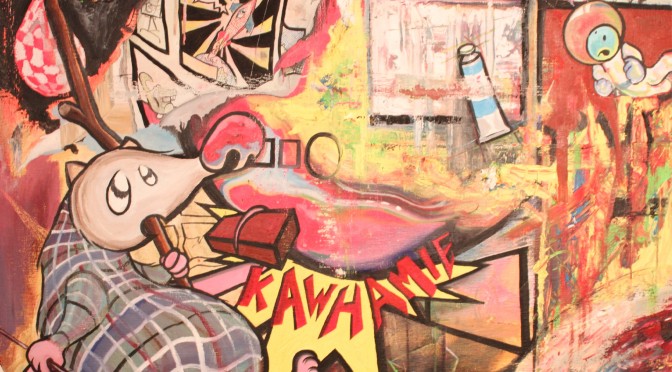
The Melchers Gray Purchase Award Showcase is a retrospective of all the outstanding student recipients of this award. Each year, artworks are purchased from students by the UMW Galleries and become part of its permanent collection. Since the founding of the Purchase Award in 1995, the Galleries have collected over twenty paintings, photographs, sculptures, and multimedia works by students which will be shown together for the very first time.


