The World as We Know It

Andy Holtin + Galo Moncayo

Ridderhof Martin Gallery

May 21- July 30, 2015

Opening Reception: May 21, 5-7pm

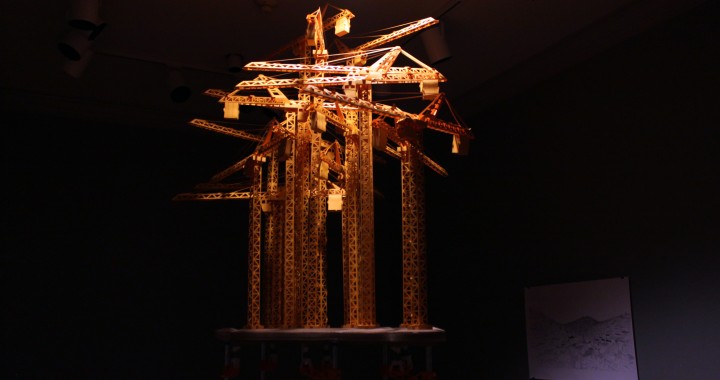
Andy Holtin and Galo Moncayo, working together as CausalityLabs, create works that explore the nature of the world through a kind of mechanical theatre with humor and mimicry. Their collective works dig into materials and events to get at our notions of meaning, sequence and cause and effect. Holtin is a professor of sculpture at American University. Moncayo is currently a member of the Studio Hadid master class at the Universität für Angewandte Kunst in Vienna, Austria.

IMG_1434

Annual Student Art Exhibition

duPont Gallery

April 8- April 26, 2015

Opening Reception: April 8, 4-6PM

Juried by Tosha Grantham

JUROR BIO: Grantham is the Curator of 2nd St. Gallery in Charlottesville Virginia, Tosha Grantham. Grantham earned a B.A. in art history from Georgetown University, a M.A. in art history from Howard University, and is a Ph.D candidate in art history in the Department of Art History and Archeology at the University of Maryland, College Park. Grantham was the David C. Driskell Fellow in Museum Studies at the Walters Art Museum (2006) and the Department of Art History and Archeology Museum Fellow at the Walters Art Museum (2007) along with several other accolades during her work as an artist, curator, adjunct professor, and museum educator.

Award Winners

Emil R. Schnellock Award for Excellence in Painting: Peggy Childers by Marie (Ria) Firth

Anne Elizabeth Collins Memorial Art Award: June Beach by Kristie Smith

Melchers Gray Purchase Award in Studio Art: A Lawful Order by Taylor White

Award in Excellence: Untitled V by Christine Valvo

Award in Excellence: Crow by Maddox Palmer

Award in Excellence: Grimm Series by Ashley Most

 Exhibition Opening Reception:

Exhibition Photos

Lily Cox-Richard: The Stand (Possessing Powers)

Ridderhof Martin Gallery
March 18- May 3
Reception: March 18, 5-7pm

Artist’s Talk: March 19, 4-5pm

Lily Cox-Richard is an award winning artist who earned her MFA in Sculpture and Extended Media at Virginia Commonwealth University in Richmond, Virginia and her BFA in Jewelry/Metal Arts at California College of the Arts in San Francisco, California. Cox-Richards won the Smithsonian Artist in Research Fellowship (2012), she was the University of Michigan Society of Fellows, Ann Arbor, MI (2012-2013), and  received the Faculty Seed Grant from the Institute for Research on Women and Gender, University of Michigan (2012).
Her exhibition, The Stand (Possessing Powers), is a set of sculptures that reference Neoclassical sculptor Hiram Powers’ great works. Powers created sculptures that emphasized the beauty of the physical body. Cox-Richard recreates the stands that these sculptures were placed on to emphasize how the stands themselves accent and amplify the sculptures. Some of Powers’ pieces that Cox-Richard re-creates  include The Greek Slave, The Last of the Tribes, and Eve Tempted.

Artist Statement

In The Stand (Possessing Powers) , I explore the history of sculpture as it relates to the myths and allegories used to promote American national and artistic identity in the 19th century. I am creating a series of sculptures based on works by the American neoclassical sculptor, Hiram Powers. In his works, idealized female figures symbolize allegorical themes. Further reducing subtractive sculpture, I am recarving these works without the figures, focusing on the elements that structurally support the figure. By co-opting Powers’ works and making them my own, I aim to complicate the gender and implicit sexuality of both sculpture and sculptor. Reduced to their structural supports, my carved plaster sculptures are both originals and copies, homage and critique, familiar and strange, created in an attempt to see what new content might be revealed when the figure is removed, and how this work can be transformed when it is reimagined through a contemporary sculpture practice.

Exhibition Opening:

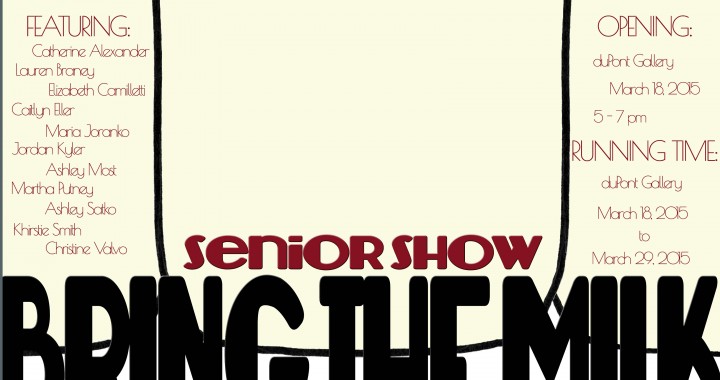
Senior Exhibition II

duPont Gallery
March 18- March 29, 2015
Opening Reception: March 18, 5-7pm

Featuring work by Catherine Alexander, Lauren Braney, Elizabeth Camilletti, Caitlyn Eller, Maria Joranko, Jordan Kyler, Ashley Most, Martha Putney, Ashley Satko, Khirstie Smith, Christine Valvo

milkposter2


Exhibition Opening:

Exhibition Photos


Pretty. Good. Art.

Senior Exhibition I
duPont Gallery
February 18- February 27, 2015
Opening Reception: February 18, 5-7pm

Featuring the work of:

Michelle Enfiejian, Travis Jarrells, Alison Lee, Rachel Deutch, Marie Firth, Madeleine Rhondeau, and Ashley Stephens

Artist Statements:

Ashley Stephens:  My work explores the duality of my cultural identity as an Iraqi-American.  I am fascinated with Middle-Eastern culture, politics, and religion and how they relate to the American political perspective.  Portraying the many conflicts that are taking place in the Middle-East today is the subject of my work.  I combine this with the American politics that negatively eaffect the Middle-Eastern world, and mainly portray America as an antagonistic character.  I incorporate all of these different aspects into my artwork because it is a subject that is highly criticized and one that is typically viewed from a journalistic standpoint and rarely from an artistic one.

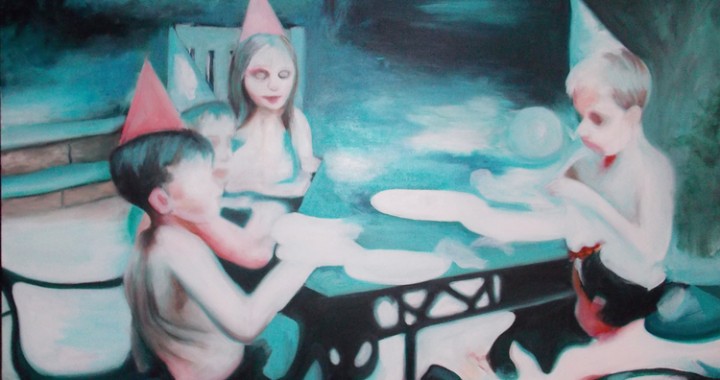
Madeleine Rhondeau:  As children, our awareness is shaped in color and light and temperature. Memories dull, yet flicker, in brilliant color. Blues and reds and pale pink knees.  As the thoughts are stretched and pulled by time, they become someone else’s memories. You don’t recognize them as your own, and it becomes difficult to place yourself within them. Passing thoughts become blindingly bright, distracting and protective. A photograph offers a small window into a distorted scene, but the perspective and opine is of another. You stare at a small self on glossy paper yet only perceive a foreign body receding into the background. Innocence is bliss.  Only upon correction did you realize you meant ignorance, and it only becomes harder when you realize you are no longer ignorant or innocent.

Rachel Deutch:  Through painting I describe the world as I see it. In my work, visual translation from source to outcome reveals and accentuates observable qualities to which I am attuned. My work evolves as I meticulously study my source and respond to new discoveries within it and the painting. Although I find myself consciously looking for contrasts to push and nuances to capture, I am more interested in the decisions I make unconsciously. A skilled translator is able to interpret one language seamlessly into another, without over thinking it. I desire to develop the same fluency in the language of painting, whereby translation becomes second nature and characteristics unique to the medium itself set it apart. I gravitate toward sources that are, to my eye, rich in visual information. The face and figure, in particular, provide a range of subtle variations and extreme contrasts, as well as a unique set of shape, edge, and line relationships, all of which crave exploration. I appropriate from photographic imagery as well as art historical precedents to reinterpret the stories or people others have described through visual media and to construct my own narratives and perspectives. As I paint from these sources, elements that get “lost in translation,” contribute to ambiguous and sometimes bizarre representations that give more importance to the medium than to the message.

Travis Jarrells:  We are assemblages of possible paths, a microcosm of our environment, the reflective surface placed opposite existence. We, limited by the breadth of our surface, disclose the so-called truths of being. We remain confined by our own reliance on semiotic constructions however, and our interpretations are limited by biological processes. My work is a meditation on the physicality of humanity’s existential confinement. I search for meaning in the ways we continually frame our consciousness within the contexts of social frameworks and narrative systems.

Michelle Enfiejian: What fascinates me is farm life in all itʼs aspects. The animals, buildings, plants and other cultivated objects inspire the hidden rustic artist within myself. I focus on the imperfect and folksy beauty that is found in our world and bring it to your attention by exaggeration. I strive to portray the playfulness found in the realm of agriculture, and bring it to life in a nontraditional fashion. I enjoy inserting imperfect, whimsical elements into my pieces, so that the viewer may see them in a new light and is able to interpret farm life differently. This is accomplished by using the colorful, organic palette of the farm and by judicious, but creative use of double entendres as muse.

Alison Lee:  A desire to explore the multitude of intriguing places and landscapes in the world has overcome me, and with it I have developed a deep fascination for maps.  My work stems from the topics of location and topography, as the pieces I create continue this exploration through the intermingling of maps with wood.  The wood grain provides natural contour lines, which hold a topographic likeness, as well as reference the man-made lineation on maps themselves.  Instead of hiding the lumber and covering it completely, the substrate serves as a part of the work itself.  Doing so allows the untouched areas to yield their own shapes and passages, further alluding to topographical regions.  Relationships begin to form between the materials themselves, as well as between the viewer and their own explorative desires.



Ridderhof Martin Gallery
January 15- February 27
Reception: January 15, 5-7pm
Artist’s Talk: January 16, 4-5pm

Artist’s Statement:

Within my system the plant is excavated, arranged in the studio, photographed, then illustrated digitally in such a way as to render the edible parts in color while the remaining parts, less emphatically, read as photograms. The plants in these images hover above an infinitely black space, referencing contact prints of botanical specimens from the dawn of photography. The 1:1 ratio of the photographs and high resolution color-coding speak to hyper-realistic modes of imaging and serve as archive and guide for an uncertain ecological future.

While this type of art may appear atavistic, its redeployment, in the precise moment of history, is viatlly relevant to issues of sustainability and consciousness. These edible plants grow all around us, in yards, alleys, ditches, and empty lots. Each testifies to our symbiotic evolution with all of life. and functions as both poetic metaphor and concrete proof of our intimate tether to the natural world. It is my hope that this art foments contemplative wonderment by offering viewers both information and insights that if realized kindle a reconnection to the natural world and a mystical counterbalance to scientific objectivism.

I envision this as a thoroughly inclusive catalogue that will result in hundreds of photographs. The aesthetic consciously combines empirical and visionary traditions, by taking advantage of digital imaging’s capacity to create rhetorical shifts in the photograph. The resulting images are elegant, layered, historically aware and able to evoke mystery, amplify interconnectedness and offer a critique of classical taxonomy.


To know the spirit of a place is to realize that you are a part of a part and that the whole is made of parts, each of which is a whole. You start with the part you are whole in.” – Gary Snyder


Opening Reception

Exhibition Photos


J.W. Fike’s Photographic Survey of the Wild Edible Botanicals of the North American Continent