Julien Binford, Untitled (man on horse in pink), oil pastel on paper, promised gift of Maureen Paige, L.2023.MP200.Julien Binford, Untitled (black abstraction with green and red), oil pastel on board, promised gift of Maureen Paige, L.2023.MP199.
Throughout his artistic career, Julien Binford concerned himself with painting the world as he experienced it directly. From his gouaches in Paris to his sketches of everyday life in Powhatan County, he primarily focused on figurative compositions inspired by his personal environment. However, as the art world saw an insurgence of abstraction in the 1950s and 1960s, Binford began working in a non-figurative style. Although limited in quantity, as he quickly returned to his familiar art form, Binford’s abstractions exhibit the artist’s experimentation with various techniques while maintaining his devotion to color.
Julien Binford, Untitled (blue and red abstraction), pastel on paper, mounted on board, promised gift of Maureen Paige, L.2023.MP202.
Julien Binford, Untitled (abstraction with purple and orange), oil paint on canvas, promised gift of Maureen Paige, L.2023.MP211.Julien Binford, Untitled (blue and beige abstraction), pastel on paper, promised gift of Maureen Paige, L.2023.MP201.Julien Binford, Untitled (purple, yellow, and black abstraction), oil paint on canvas, promised gift of Maureen Paige, L.2023.MP206.Julien Binford, Untitled (abstraction with green border), pastel on paper, mounted on board, promised gift of Maureen Paige, L.2023.MP203.
Julien Binford, Untitled (two nudes in blue),1934, watercolor on board, promised gift of Maureen Paige, L.2023.MP125.
The young Julien Binford did not initially intend on pursuing a career in the fine arts. Instead, he enrolled at Emory University to study at their premedical school. However, while enrolled at the University, Binford developed a proficiency in the renderings of dissections to which Roland McKinney, the then director of the Atlanta High Museum, took notice. With encouragement from McKinney, Binford left his family in Atlanta to enroll at the Art Institute of Chicago. During his formal art education, he studied under the great Russian colorist Boris Anisfeld, a contributing factor to his great devotion to color theory. After graduating in 1932, he was awarded the Edward L. Ryerson Traveling Fellowship that took him to Paris. While abroad, Binford is said to have worked incessantly, experimenting with both mediums and textures. At night, after he had finished painting, he walked the city and sketched his surroundings. Although he created many ink drawings during his time in Paris, color remained his primary concern. According to his wife Elisabeth, a series of compositions in gouaches created in Paris were some of his most important works. The three works displayed here are representative of Binford’s experimentation with color and medium in 1934, at the height of his Parisian travels.
Julien Binford, Untitled (reclining nude), watercolor on board, promised gift of Maureen Paige, L.2023.MP127.
Julien Binford, Untitled (reclining nude), watercolor on board, promised gift of Maureen Paige, L.2023.MP127.
Elisabeth Bollee de Vautibault (1908-1984) was the daughter of Léon Bollée, a French automobile manufacturer who passed away in 1913 and left her a considerable estate. She was the goddaughter to Wilbur Wright, who dedicated his first flight in France to her. In 1927 she married Count Jean Maurice Gilbert de Vautibault and published several volumes of poems in French under the name Elisabeth de Vauitbault. In 1932, Julien Binford moved to Paris and spent three years studying there. In that time he met Elisabeth, who eventually divorced her then current husband to marry Binford. She moved back to Virginia with him in 1936, where they started renovations on their home, The Foundry. During the first few years in Virginia, The Foundry was uninhabitable, and the couple lived in a shack with no water, lights, or heat, and relied on farming for survival.
Julien Binford, Untitled (Elisabeth nude), paint on board, promised gift of Maureen Paige, L.2023.MP215.
“I met him one such time when he was residing in a seventeenth-century dwelling hung with damasks, antichambered with marble, altogether fitted with comfort moderne, mysterious gilt carvings and hidden stairs. I saw him at Biarritz, in Normandy, on a granite island in the English Channel. Then he went off to Spain, and when I saw him again there he was, broke again, under the skylight of the Rue Daguerre.”
– Elisabeth Bollee de Vautibault about Julien Binford in “A Wife’s View,” (1959)
As she continued to write, now in both French and English, she published the article A Wife’s View of an American Painter: Julien Binford, which presents a thorough biography of Binford’s life, and depicts her own talent in prose. Her quoting of Paul Valery became the inspiration for this exhibition’s title, as it encompassed Binford’s lifelong dedication to his exploration of color. Elisabeth passed away on July 11th, 1984, leaving behind countless sketches and paintings Binford made of her image, as well as her own volumes and writings.
Julien Binford, Untitled (portrait of Elisabeth), paint on board, promised gift of Maureen Paige, L.2023.MP222.
Julien Binford, Untitled (people by river), pastel on paper, promised gift of Maureen Paige, L.2023.MP170.
Julien Binford, Untitled (West Palm Beach), pastel on paper, promised gift of Maureen Paige, L.2023.MP172.
Between 1946 and 1948, Julien Binford completed a series of print advertisements for the Webster Tobacco Company entitled the Sunday Cigar Series. The company has since gone out of business, but copies of Binford’s posters and a few of his preparatory sketches still remain today. The two drawings above depict Palm Beach, Florida, one of the settings for the series. Both sketches are labeled with their location, and the leftmost work is additionally inscribed with “Web. Tobacco Co.” at the bottom right. These sketches, along with the ones shown below, were likely done en plein air, which is the act of painting outdoors.
The pastels done en plein air show stormy skies, various species of trees, and notable structures, such as the Washington Monument and the Thomas Jefferson Memorial in the distance. These works were likely done at the indicated locations, and depict not only some of the many places Binford visited, but also how he would have seen them. While their forms are not rendered in perfect detail, the color shines through, giving them a lifelike feel.
Julien Binford, Untitled (trees and river), pastel on paper, promised gift of Maureen Paige, L.2023.MP167.Julien Binford, Untitled (Washington D.C. skyline), pastel on paper, promised gift of Maureen Paige, L.2023.MP164.Julien Binford, Untitled (purple landscape), pastel on paper, promised gift of Maureen Paige, L.2023.MP168.Julien Binford, Untitled (landscape with white building), pastel on paper, promised gift of Maureen Paige, L.2023.MP171.
Join Aimee George for Gentle Yoga & Meditation in the duPont Gallery Park Dae Sung: Ink Reimagined exhibition. This free event is on Tuesday, Nov 14th and Tuesday, December 5th at 12:15pm. Registration is required.
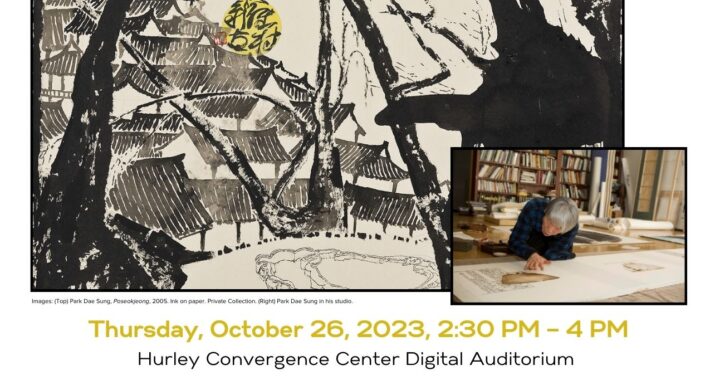
Thursday, October 26, 2023, 2:30 PM – 4 PM HCC Digital Auditorium, Free Admission
The Department of Art and Art History presents a stimulating symposium that delves into the multifaceted works of the contemporary ink artist Park Dae Sung (b. 1945). A short presentation by esteemed scholars will illuminate the diverse subjects encompassed in Park’s fascinating oeuvre, including calligraphy, landscapes, animals, and still lifes, and engage an appreciation of the exhibition at the UMW Galleries, Park Dae Sung: Ink Reimagined. Through in-depth analysis, five scholars will offer fresh insights into Park’s artistic vision, shedding light on the rich tapestry of themes and techniques employed by this masterful artist.
Topics to be covered include:
“Resurrected Ruins and Renovated Visions of Gyeongju: The Dream Journey of Park Dae Sung” by Jungsil Jenny Lee, Adjunct Assistant Professor, University of Cincinnati
“Visualizing the Ideal Relationship Between Animals and Humans: Park Dae Sung’s Zoomorphic and Anthropomorphic Images,” by Suzie Kim, Associate Professor of Art History, University of Mary Washington
“Park Dae Sung’s Way of the Brush,” by Jiyeon Kim, Curator of Korean Art, Peabody Essex Museum
“How Park Dae Sung’s Archaic Beauty Paintings Reinvent the Past,” by Jinyoung A. Jin, Director of Cultural Programs, Charles B. Wang Center
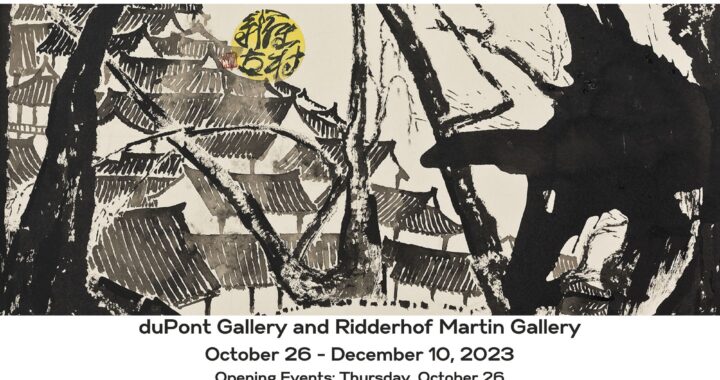
The University of Mary Washington Galleries is pleased to present the landmark exhibition, Park Dae Sung: Ink Reimagined. This exhibition showcases the extraordinary works of contemporary artist Park Dae Sung (b. 1945). Park possesses a profound mastery of traditional ink painting that he demonstrates in modern and imaginative interpretations of the natural world. Through his art, he transforms familiar Korean landscapes into vibrant, awe-inspiring compositions. Occupying both the Ridderhof Martin Gallery and duPont Gallery, this collection of nearly forty works on paper is a testament to the artist’s innovative spirit and remarkable skill.
The exhibition was curated by Suzie Kim and supported by the Korea Foundation and the Gana Foundation for Arts and Culture.
Hours & Admission: Park Dae Sung: Ink Reimagined will be on view from October 26 to December 10, 2023, in the Ridderhof Martin and duPont Galleries, with the opening reception taking place on October 26 from 5-7pm. During the opening reception, there will be a calligraphy demonstration by Korean Calligrapher Myoung Won Kwon, from 5:30-6pm, in front of duPont Gallery. Admission is always free and tours are available.