Virginia

After returning stateside in 1935, Binford and his wife, Elisabeth Bollee, settled in Powhatan County, Virginia. Upon arrival, the couple purchased the ruins of the Old Foundry, an early 19th century structure constructed along the banks of Fine Creek. Elisabeth described the state of the house as “a windy shack with no water, no lights, and no heat located on Lee’s Landing Road northeast of the Foundry.” Over the next few decades, the couple undertook massive reconstruction projects, effectively making the Old Foundry their permanent residence. 

Julien Binford, Untitled (Richmond state library sketch in green), graphite and oil pastel on paper, promised gift of Maureen Paige, L.2023.MP018.


While living in Powhatan County, Binford’s surroundings became his primary artistic inspiration. Most notably, he fostered a strong relationship with his African American neighbors, using them as the subject for his works on numerous occasions. The Virginian terrain additionally became an important source of inspiration for Binford’s artwork. This is displayed in the sketch of the Rappahannock River, as well as other sketches selected for this exhibition that feature prominent buildings from Washington D.C.

Julien Binford, Untitled (sycamores at the Rappahannock River), pastel on paper, promised gift of Maureen Paige, L.2023.MP169.


In 1950, the Virginia State Library commissioned Binford to paint a mural for their newly erected building. The work, which faced the entrance of the library and occupied approximately 14 square feet, depicted the enactment of the Virginia Declaration of Rights. The two drawings of colonial figures shown here are preparatory sketches for the mural, which has since been relocated to the Library’s Records Center.

Julien Binford, Untitled (Richmond state library sketch in red), graphite and oil pastel on paper, promised gift of Maureen Paige, L.2023.MP046.


Beginning in 1946, Binford established a relationship with the University of Mary Washington in Fredericksburg, Virginia that would last for over 25 years. As a professor of Studio Art, Binford was deeply dedicated to his students, and was considered to be the school’s “most motivational figure” of the 1940s. As stated on the University of Mary Washington website; “Fellow faculty member Edward Alvey, Jr. wrote that Binford was a warm, friendly, natural person. He painted with a sensitivity and devotion, establishing a feeling of rapport between the artist and the viewer. His work has a freshness and originality that well exemplifies Binford’s own zest for life and his desire to share its beauty with others.” 
Religious Art

In a tribute to Julien Binford, dated September 5th, 1997, an unnamed relative wrote “I know that he brought joy to the heart of his God, as well as to the hearts of who saw his work, especially the painting in Shiloh Church.”

Binford was a Southern Baptist and, when he moved to Powhatan County, integrated himself into the African American Baptist community and was both devoted to and inspired by the beauty of the rural culture. In the late 1930’s, Binford was commissioned by Shiloh Baptist Church to paint The Lord Over Jordan, a mural over the church’s baptistry that depicts Christ’s baptism. As payment, Binford accepted donations of produce in the place of money. 

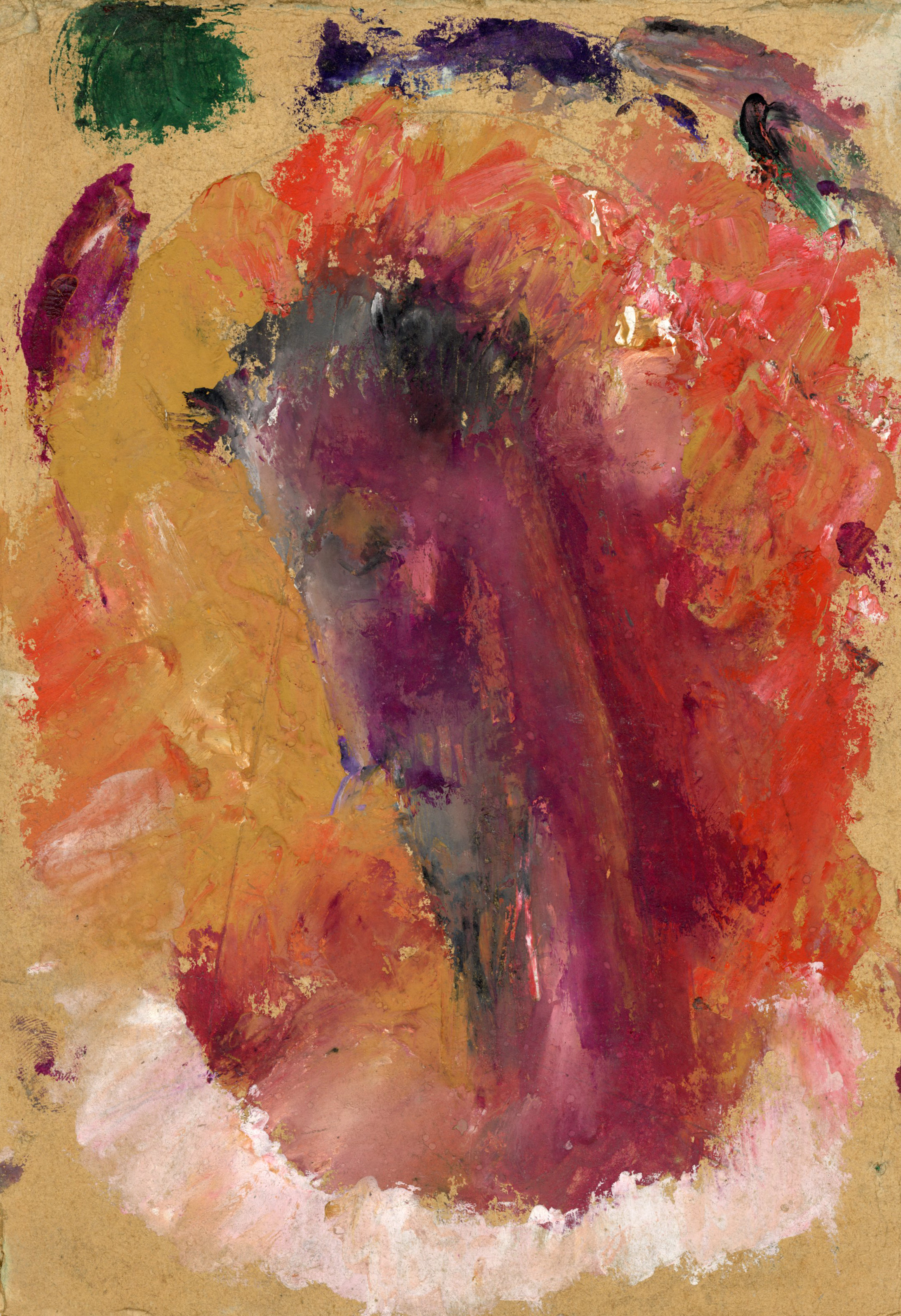
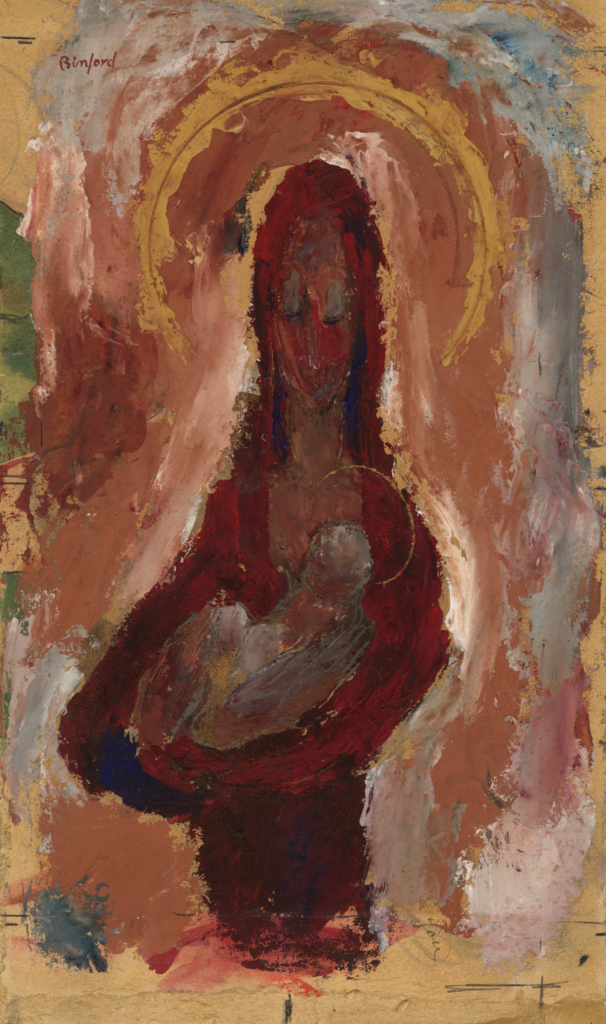
Julien Binford, Untitled (Madonna and Child), oil pastel on board, promised gift of Maureen Paige, L.2023.MP122.


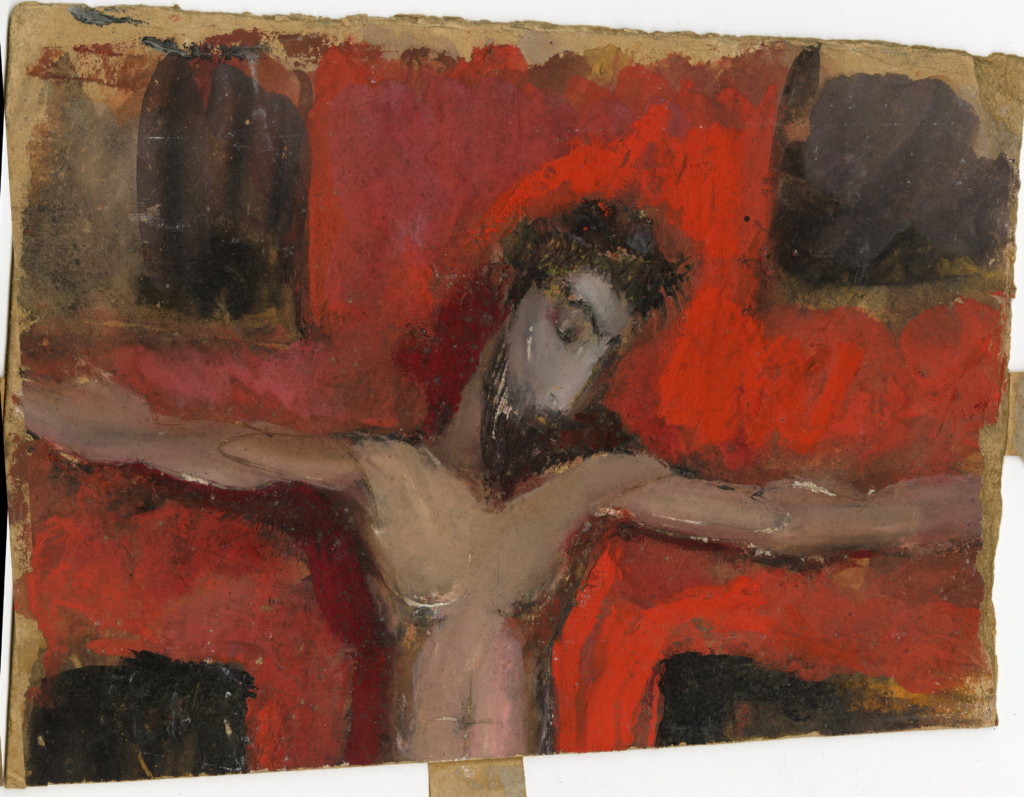
Binford’s use of color reflects his religious devotion as well as his storytelling technique – his dark reds and blacks emphasize the sacrifice made by Christ. This can be observed from his work Untitled (Madonna and Child), shown above. While the subject matter is often depicted as a joyous occasion, Binford’s use of dark red invokes the inevitability of Christ’s death. The use of foreboding colors is continued in Untitled (Crucifixion), which displays Christ suspended on a cross stained with his own blood and flanked by a pitch black sky.

Julien Binford, Untitled (Crucifixion), oil pastel on board, promised gift of Maureen Paige, L.2023.MP124.

Ungrouped Works


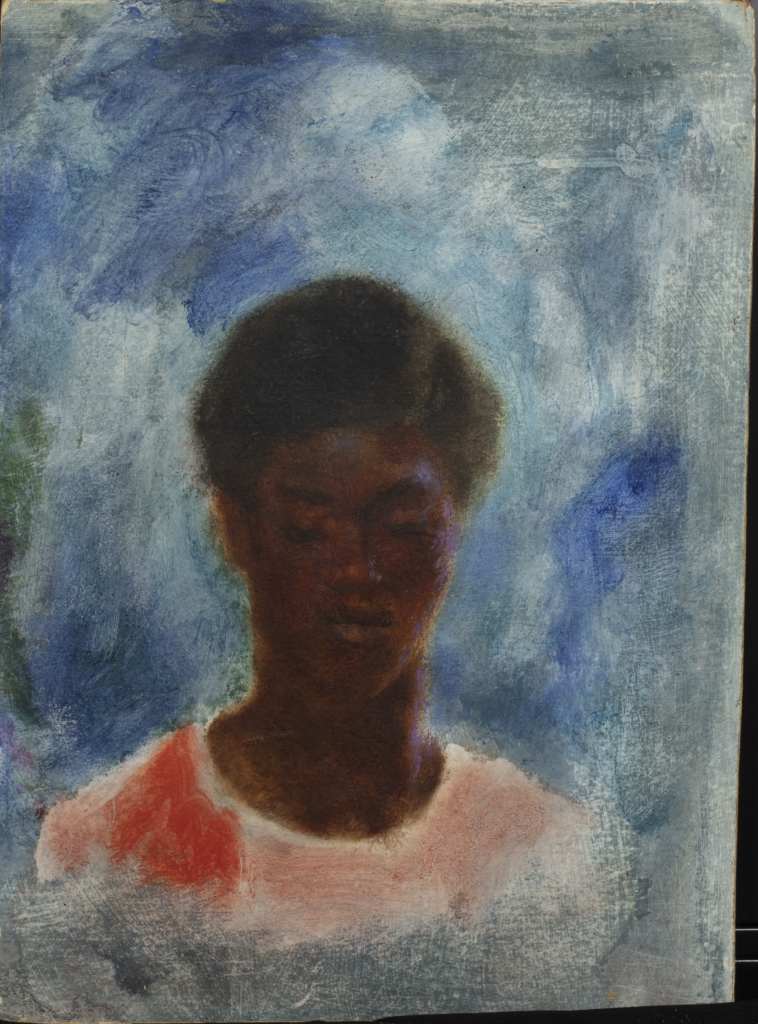
The remaining works in this exhibition are uncategorized and represent varying stylistic periods in Binford’s career, but not all of Julien Binford’s works survive today. Late in his life, the artist began struggling with the aesthetic quality of some of his pieces and decided to take action. Maureen Paige ‘70, Binford’s former student and studio assistant, describes an instance of the artist burning a number of his older works in a bonfire. Although urged by those around him to preserve his works, an unknown number were lost. However, upon request, Binford agreed not to destroy additional pieces if disclaimers were written on the back. For example, the piece to the left has “Not to be sold as a Julien Binford work” written across the back of the board.

Julien Binford, Untitled (figure in red shirt), oil paint on board, promised gift of Maureen Paige, L.2023.MP213.


Abstractions


Throughout his artistic career, Julien Binford concerned himself with painting the world as he experienced it directly. From his gouaches in Paris to his sketches of everyday life in Powhatan County, he primarily focused on figurative compositions inspired by his personal environment. However, as the art world saw an insurgence of abstraction in the 1950s and 1960s, Binford began working in a non-figurative style. Although limited in quantity, as he quickly returned to his familiar art form, Binford’s abstractions exhibit the artist’s experimentation with various techniques while maintaining his devotion to color.  

Julien Binford, Untitled (blue and red abstraction), pastel on paper, mounted on board, promised gift of Maureen Paige, L.2023.MP202.


Time in Paris

Julien Binford, Untitled (two nudes in blue),1934, watercolor on board, promised gift of Maureen Paige, L.2023.MP125.

The young Julien Binford did not initially intend on pursuing a career in the fine arts. Instead, he enrolled at Emory University to study at their premedical school. However, while enrolled at the University, Binford developed a proficiency in the renderings of dissections to which Roland McKinney, the then director of the Atlanta High Museum, took notice. With encouragement from McKinney, Binford left his family in Atlanta to enroll at the Art Institute of Chicago. During his formal art education, he studied under the great Russian colorist Boris Anisfeld, a contributing factor to his great devotion to color theory. After graduating in 1932, he was awarded the Edward L. Ryerson Traveling Fellowship that took him to Paris. While abroad, Binford is said to have worked incessantly, experimenting with both mediums and textures. At night, after he had finished painting, he walked the city and sketched his surroundings. Although he created many ink drawings during his time in Paris, color remained his primary concern. According to his wife Elisabeth, a series of compositions in gouaches created in Paris were some of his most important works. The three works displayed here are representative of Binford’s experimentation with color and medium in 1934, at the height of his Parisian travels.

Julien Binford, Untitled (reclining nude), watercolor on board, promised gift of Maureen Paige, L.2023.MP127.


Julien Binford, Untitled (reclining nude), watercolor on board, promised gift of Maureen Paige, L.2023.MP127.

Elisabeth Bollee de Vautibault

Elisabeth Bollee de Vautibault (1908-1984) was the daughter of Léon Bollée, a French automobile manufacturer who passed away in 1913 and left her a considerable estate. She was the goddaughter to Wilbur Wright, who dedicated his first flight in France to her. In 1927 she married Count Jean Maurice Gilbert de Vautibault and published several volumes of poems in French under the name Elisabeth de Vauitbault. In 1932, Julien Binford moved to Paris and spent three years studying there. In that time he met Elisabeth, who eventually divorced her then current husband to marry Binford. She moved back to Virginia with him in 1936, where they started renovations on their home, The Foundry. During the first few years in Virginia, The Foundry was uninhabitable, and the couple lived in a shack with no water, lights, or heat, and relied on farming for survival.

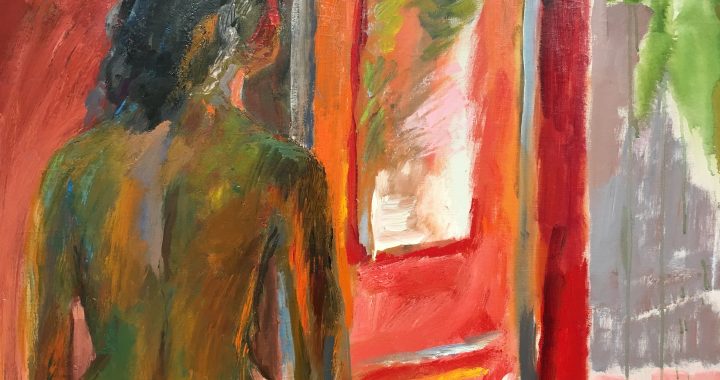
Julien Binford, Untitled (Elisabeth nude), paint on board, promised gift of Maureen Paige, L.2023.MP215.


“I met him one such time when he was residing in a seventeenth-century dwelling hung with damasks, antichambered with marble, altogether fitted with comfort moderne, mysterious gilt carvings and hidden stairs. I saw him at Biarritz, in Normandy, on a granite island in the English Channel. Then he went off to Spain, and when I saw him again there he was, broke again, under the skylight of the Rue Daguerre.”

– Elisabeth Bollee de Vautibault about Julien Binford in “A Wife’s View,” (1959)

As she continued to write, now in both French and English, she published the article A Wife’s View of an American Painter: Julien Binford, which presents a thorough biography of Binford’s life, and depicts her own talent in prose. Her quoting of Paul Valery became the inspiration for this exhibition’s title, as it encompassed Binford’s lifelong dedication to his exploration of color. Elisabeth passed away on July 11th, 1984, leaving behind countless sketches and paintings Binford made of her image, as well as her own volumes and writings.

Julien Binford, Untitled (portrait of Elisabeth), paint on board, promised gift of Maureen Paige, L.2023.MP222.

Webster Tobacco

Julien Binford, Untitled (people by river), pastel on paper, promised gift of Maureen Paige, L.2023.MP170.
Julien Binford, Untitled (West Palm Beach), pastel on paper, promised gift of Maureen Paige, L.2023.MP172.

Between 1946 and 1948, Julien Binford completed a series of print advertisements for the Webster Tobacco Company entitled the Sunday Cigar Series. The company has since gone out of business, but copies of Binford’s posters and a few of his preparatory sketches still remain today. The two drawings above depict Palm Beach, Florida, one of the settings for the series. Both sketches are labeled with their location, and the leftmost work is additionally inscribed with “Web. Tobacco Co.” at the bottom right. These sketches, along with the ones shown below, were likely done en plein air, which is the act of painting outdoors.

The pastels done en plein air show stormy skies, various species of trees, and notable structures, such as the Washington Monument and the Thomas Jefferson Memorial in the distance. These works were likely done at the indicated locations, and depict not only some of the many places Binford visited, but also how he would have seen them. While their forms are not rendered in perfect detail, the color shines through, giving them a lifelike feel.